Introduction
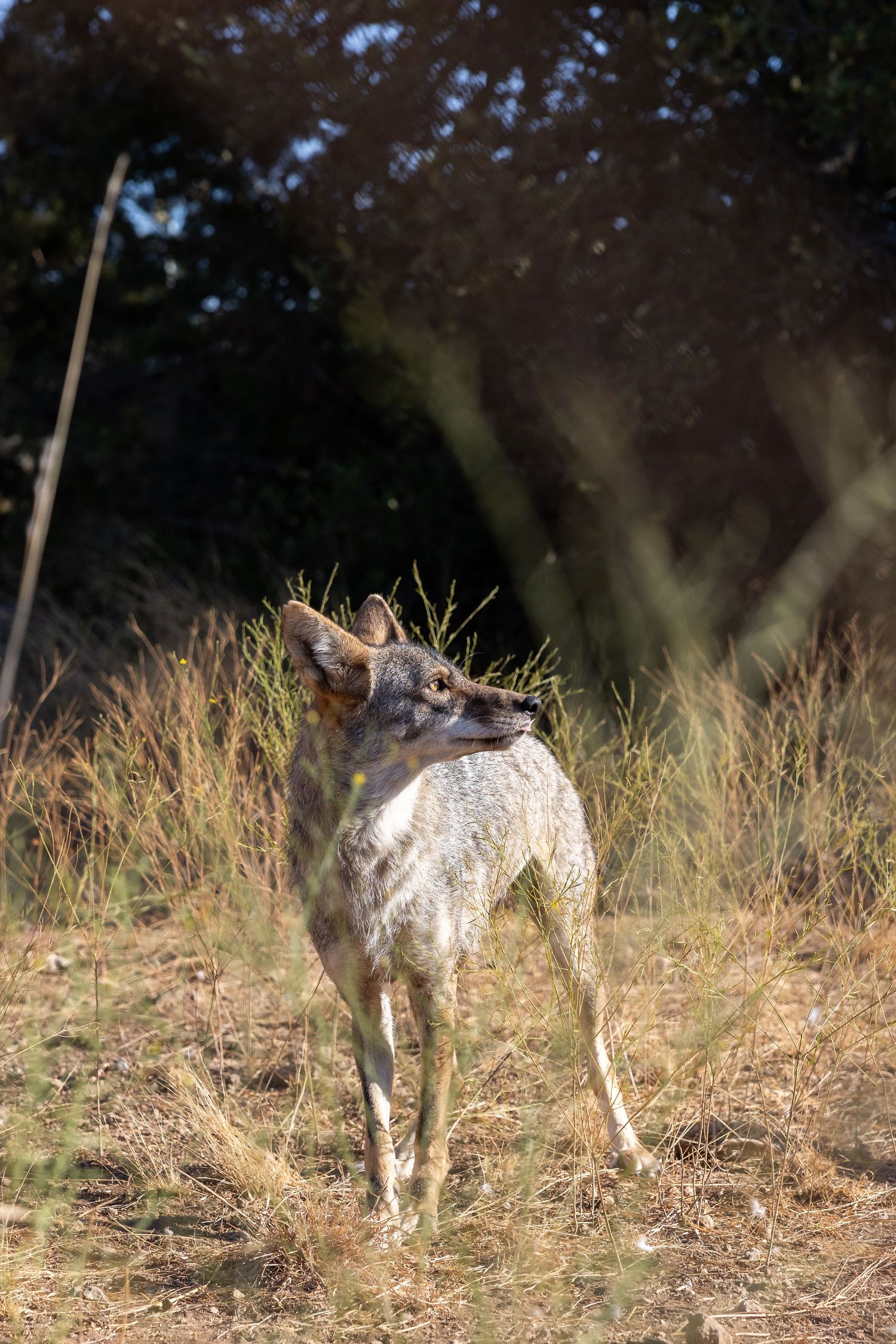
A young female coyote — known here as Solana — became a permanent resident of the sanctuary this year. While details surrounding her arrival are intentionally kept confidential, long-term placement was deemed appropriate for her well-being.
This account summarizes behavioral observations during her first three months, emphasizing adaptation, social interest, and environmental engagement.
Month 1 — Assessment & Territory Mapping
Solana immediately began exploring her new space with methodical consistency.
Coyotes are highly perceptive animals, and within days she identified favored paths and sheltering locations.
Observed Behaviors
Regular scent marking
Nocturnal pacing
Burrowing attempts under brush piles
Quiet scanning during daytime
She displayed strong interest in naturalistic scents placed within the enclosure (fur, feathers), tracking them with nose-to-ground focus.
Her eating patterns were steady; she carried food to secluded spots before consumption, suggesting instinctual caching behavior.
Month 2 — Enrichment Motivation & Increased Confidence
By Month Two, Solana’s pacing reduced, replaced by investigative movement and enrichment-driven exploration.
She engaged with:
Scent trails
Hidden food challenges
Elevated lookout structures
Her response to auditory enrichment — distant coyote calls — was particularly notable. She exhibited alert ears, exploratory pacing, and occasional soft yips.
She also remained visible during staff presence, sitting several meters away while observing quietly.
Month 3 — Social Curiosity & Behavior Stabilization
In Month Three, Solana was given visual access to another coyote. Early curiosity was expressed through slow approach, lowered tail, and neutral ears. Both individuals rested near the shared fenceline at different times, suggesting affiliative comfort.
Caching behavior evolved — she buried only select items, retrieving them predictably.
She also began performing playful bounds during early morning, indicating reduced stress and growing environmental ease.
Conclusion
Solana integrated into sanctuary life with clear patterns of cognitive mapping, enrichment responsiveness, and social curiosity.
Key takeaways:
Territorial orientation progressed into relaxed exploration
Enrichment played a central role in confidence building
Social interest emerged naturally when given choice-based introduction
Food behaviors became more deliberate and varied
Her status as a permanent resident allows for continuing study of:
Social cognition
Emotional regulation
Environmental memory
Her adjustment demonstrates the ability of coyotes to form stable behavioral rhythms within managed environments designed around safety and autonomy.